The White Belt Journey at Gracie Barra Northridge Jiu-Jitsu Explained
The White Belt is the first step in Brazilian Jiu-Jitsu (BJJ). It is widely considered the most difficult belt—not because the techniques are the hardest, but because it is the period where the vast majority of students quit.
At Gracie Barra Northridge, under the guidance of Professor Romulo Barral, the White Belt journey is structured, safe, and designed to transform a complete novice into a competent grappler over the course of 12 to 24 months.
Here is what that timeline looks like, step-by-step.
Phase 1: The “Survival” Phase (Months 1–3)
Goal: Acclimatization and Safety.
When you first tie on the white belt at GBN, you are not expected to fight; you are expected to learn how to move.
The GB1 Curriculum: You will exclusively attend the GB1 Fundamentals classes. You will cycle through a 16-week curriculum covering essential self-defense and ground basics.
Body Awareness: You will feel uncoordinated. You will learn movements like “shrimping” (hip escapes) and “bridging.” You will realize how exhausting grappling is, even when you aren’t doing much.
Learning to Tap: The most important lesson in this phase is leaving your ego at the door. You will learn that “tapping out” (slapping the mat or your opponent) signals “I give up, you got me.” This is not losing; it is learning.
The Attendance Card: At GBN, your progress is tracked via an attendance card. You check in for every class. This is vital because promotions at the White Belt level are largely based on consistency and class count.
Phase 2: The First Stripe & “The Bug” (Months 3–6)
Goal: Understanding the Vocabulary.
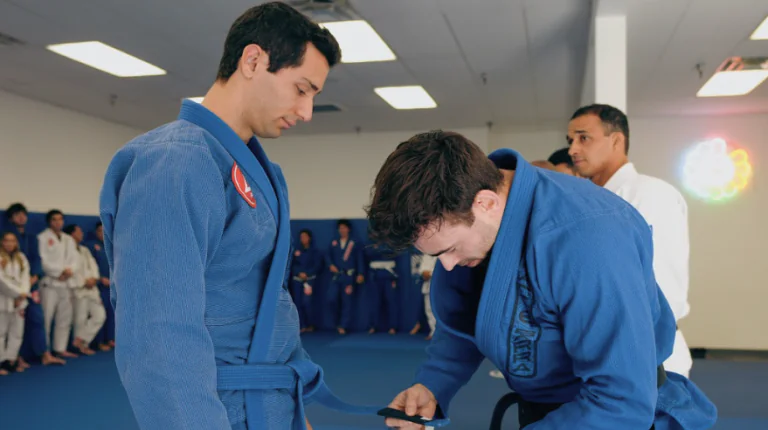
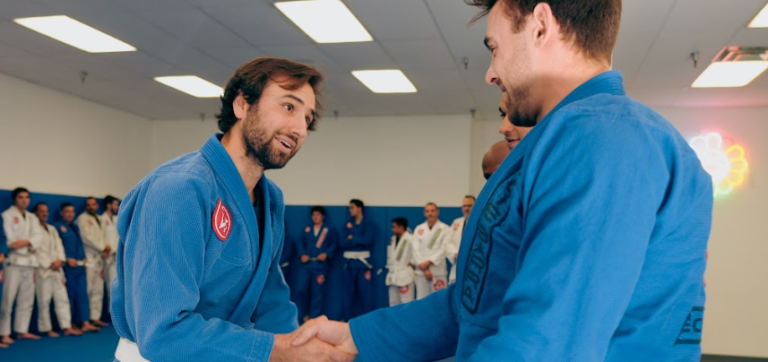
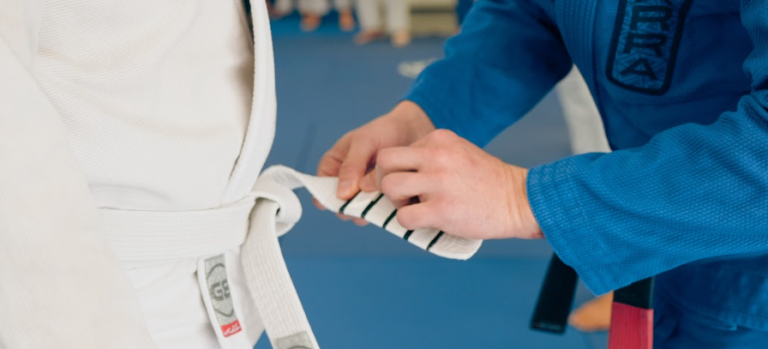
After consistent attendance (usually around 30–50 classes), your professor will call your name at the end of class and place a piece of white athletic tape (a stripe) on the black bar of your belt.
What the Stripe Means: It does not mean you are a master. It means you are showing up, paying attention, and you understand the basic movements.
Connecting the Dots: You stop seeing techniques as isolated moves and start seeing connections. You understand that a “Guard Pass” leads to “Side Control,” which leads to “Mount.”
Introduction to Sparring (Rolling): Depending on the instructor’s assessment, you may begin “rolling” (live wrestling) toward the end of class. This is where the addiction sets in—often called “catching the Jiu-Jitsu bug.” You will likely lose every round, but you will be fascinated by how you lost.
Phase 3: The “Blue Belt Blues” Pre-Cursor (Months 6–12)
Goal: Defense and Survival.
By now, you likely have two stripes. You are no longer the newest person in the room. New students will walk in, and you will realize you can actually control them.
Defensive Focus: At GBN, a white belt is not expected to have a dangerous offense. Your job is to survive. Can you keep a larger opponent from mounting you? Can you escape a headlock? If you can survive for 5 minutes without getting submitted, you are winning.
The Physical Change: Your body will change. Your cardio improves, your grip strength increases, and you lose the “panic response” when someone puts weight on you.
The Northridge Standard: You will realize that a 2-stripe white belt at Gracie Barra Northridge is often tougher than white belts from other academies. Because you are training under world-class competitors, the standard of technique required to succeed in the room is higher.
Phase 4: Refining for the Next Level (Months 12–18+)
Goal: execution and Efficiency.
You are now a 3 or 4-stripe white belt. You are nearing the end of the beginning.
Efficiency: You stop using 100% of your strength to do a move. You start using leverage. You stop holding your breath while fighting.
GB2 Transition: You may be invited to try GB2 (Advanced) classes. This is a major step. You will be exposed to more complex techniques (berimbolos, leg locks, spider guard) and will train with Blue, Purple, and Brown belts who will test your defense significantly.
Mentorship: You start helping the Day 1 students. Teaching them how to tie their belts or do a warm-up drill solidifies your own knowledge.
The Graduation: The Blue Belt
There is no formal “test” or exam day at Gracie Barra Northridge. You do not pay a fee to grade up.
Promotions usually happen during a seminar or a special promotion night. Professor Romulo Barral or the head instructors evaluate you based on:
- Technical Knowledge: Do you know the core moves?
- Sparring Ability: Can you defend yourself against a fully resisting opponent?
- Character: Do you treat training partners with respect? Do you represent the GBN shield well?
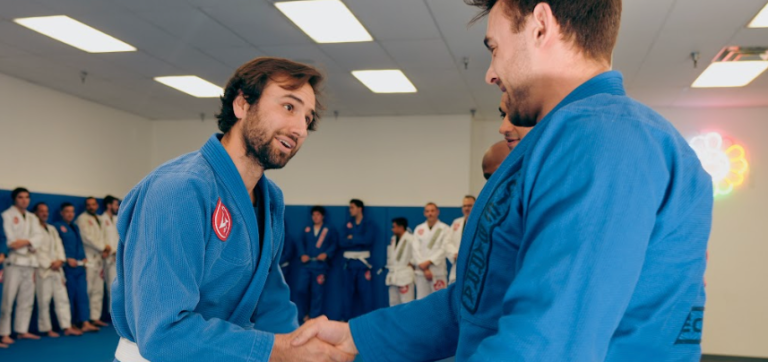
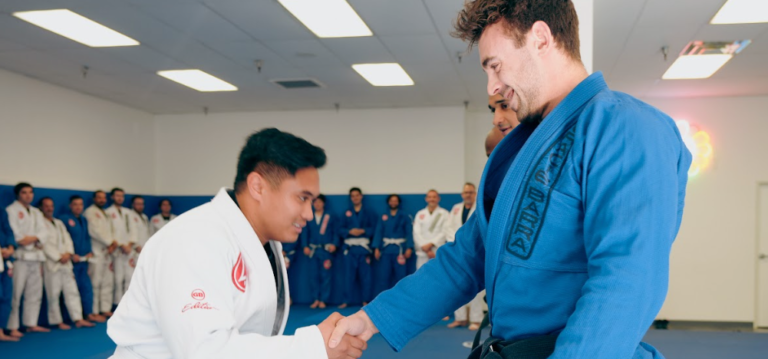
When you receive your Blue Belt, it signifies that you have a working knowledge of Jiu-Jitsu. You are no longer a beginner; you are a student of the game who is now ready to start developing your own unique style.
Summary of the Experience
The White Belt journey at Gracie Barra Northridge is a lesson in humility. You will be crushed, sweaty, and frustrated. But you will be supported by a team that wants you to succeed. The journey takes you from a person who fears conflict to a person who is comfortable in the most uncomfortable situations imaginable.
Gracie Barra Northridge Location & Contact:
Address: 19520 Nordhoff St 10th, Northridge, CA 91324
Phone: +1 818-357-4074
info@gbnorthridge.com
Website: gbnorthridge.com
Hours
Mon-Thurs: 12 PM to 9 PM
Fridays: 12 PM to 7 PM
Saturdays: 9 AM to 2 PM
Sundays: CLOSED
The White Belt Journey at Gracie Barra Northridge Jiu-Jitsu Explained
Route
Gracie Barra Northridge Brazilian Jiu-Jitsu & Self Defense
Phone: +1 818-357-4074Secondary phone: +1 818-357-4074
Email: info@gbnorthridge.com
URL: https://gbnorthridge.com/
| Monday | 12:00 PM - 9:00 PM |
| Tuesday | 12:00 PM - 9:00 PM |
| Wednesday | 12:00 PM - 9:00 PM |
| Thursday | 12:00 PM - 9:00 PM |
| Friday | 12:00 PM - 7:00 PM |
| Saturday | 9:00 AM - 2:00 PM |
| Sunday | Closed |